Everyday Business Automations
Build Status
Built and live tested
Three small, standalone automations built to prove that not every workflow needs to be a big system: a contact form that notifies and auto replies, an invoice reminder that chases overdue payments, and a review request automation that follows up after a job is done.
Results
100%
Decision Logic Verified Against Real Seeded Outcomes Before Going Live
5 to 7
Nodes per Workflow, Trigger, Decide, Act, Nothing Extra
3
Standalone Automations, Each Live Tested Against Real Data
Inside the Build
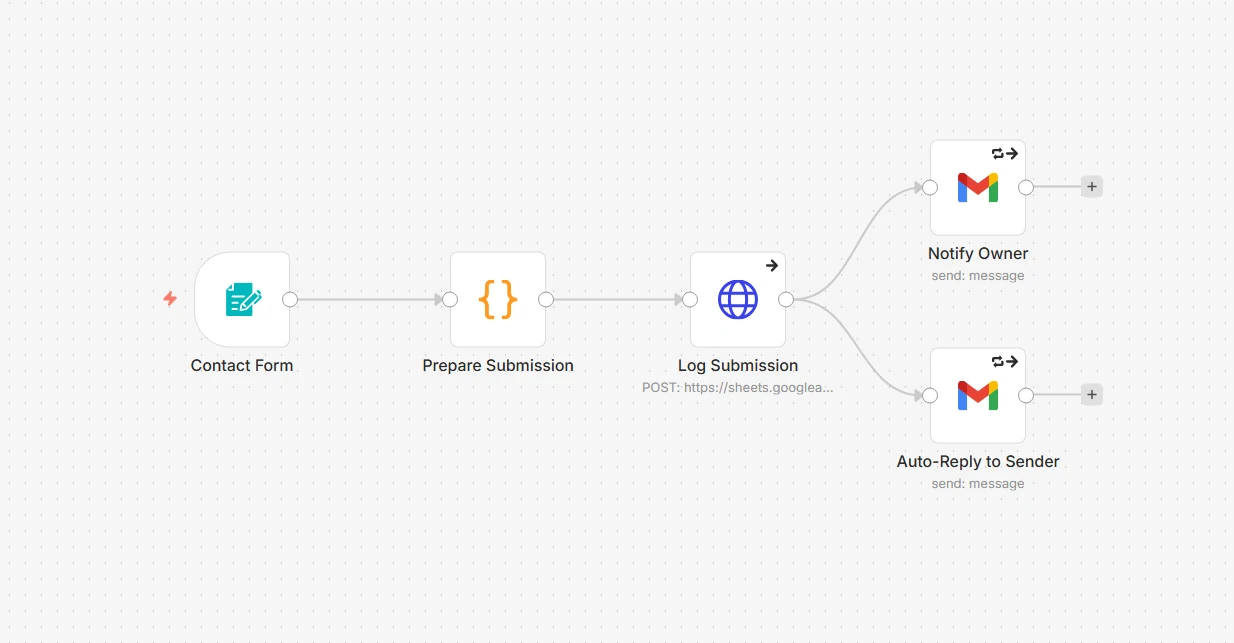
The Complete Workflow Canvas.
Scenario Replay
See How the Logic Responds.
Choose a real world situation to follow the path from trigger to outcome.
Trigger
A prospective customer submits an enquiry.
Prepare submission
Log the enquiry
Notify the owner
Reply to the sender
Outcome
The business is alerted and the customer knows their message arrived.
Operational Change
What Changes After Automation.
Enquiries
Can disappear into an inbox
Logged, acknowledged, and announced
Invoice follow up
Depends on someone remembering
Checked automatically every morning
Review requests
Sent inconsistently or too late
Triggered from completed job data
The Challenge
Most small businesses don't need an elaborate system, they need the basics handled reliably: a contact form that doesn't go into a void, invoices that get chased without someone having to remember, and a way to ask happy customers for a review before the moment passes.
The System
We built three independent n8n workflows, each doing exactly one job well and following the same lightweight pattern, trigger, decide, act, nothing extra: contact form notify + auto reply, staged invoice payment reminders, and post job review requests two days after completion.
Guardrails
Each workflow does one bounded job.
State updates prevent repeated messages.
Sheets stay readable and editable.